Facilities
 |
Beam-Down Solar Thermal Concentrator (BDSTC)
The Masdar City Beam Down Facility was designed by the Tokyo Institute of Technology and built by Japan’s Mitsui Engineering and Shipbuilding Company. The system is comprised of 33ganged-type heliostats, surrounding the central tower, on top of which a faceted secondary mirror is mounted to concentrate the light on a high albedo target used for photographic flux mapping on a Lambertian receiver.
Click here to read more...
The heliostat field is designed for research’s convenience, not to be implemented on the utility scale. They are arranged in three concentric rings designated by letters with the closest ring called ring (A) and the furthest one (C). The numbers attached to these letters on the drawing increase in an anticlockwise manner with respect to the south of the field (pointing towards the top of the page). Note that four heliostats are missing from the each sector, one from the A-ring and three from the C-ring. This explains why there are 45 rather than 33 secondary mirrors on the central reflector (CR): the facility’s power capacity can be increased by ~35% by the addition of the aforementioned heliostats corresponding to the 12 additional secondary mirrors fitted on the tower. Each heliostat is comprised of 43 facets – canted at different angles to create a Fresnel reflector such that the rays incident on the center of each facet will intersect (were the central reflectors absent) at a point on the tower axis well above the central reflector (CR) deck (heliostats’ imaginary focal point shown in Figure 1). The 43 facets are distributed among 3 panels. The two out board panels each have 14 (7 by 2) 0.2025 m2 facets. The middle panel has two half facets above and below the central facet. This central facet is used to control the heliostat’s tracking. The area per heliostat is 8.5 m2 yielding a total flat mirror area of 280.5 m2 for the entire field. Figure 2 shows the layout of a typical heliostat.

Figure 2: (a.) Facet arrangement of a single heliostat. The center panel has an elevation-tracking motor and is connected to the front and back panels by two 4-bar linkages as seen in (b.)
The three panels are connected by two 4-bar linkage mechanisms sharing a common crank arm such that their elevation angles are simultaneously controlled. The panels ride on a circular frame at the center of which is a hub where the azimuthal tracking motor is located. Together the elevation and azimuth mechanisms and motors enable two-axis (altitude-azimuth) tracking.
These unconventional heliostats allow for a better utilization of land space and a more compact system design compared to all other heliostats. Tamaura et. al also mentioned in 14 a potential for lowering costs as a result of using this arrangement. As noted previously however, these research-only heliostats and field arrangement are not meant for mass production and will lead to increased losses due to blocking, shading, as well as inefficient solar collection due to increased cosine losses. These effects have an adverse impact the potential performance of the BDOE, especially during the early hours of the day and late in the evening where the effects of shading and blocking are most pronounced.
Central Tower Reflectors (CRs)
The central tower is over 20 meters in height, housing 45 fixed, flat CR mirrors with tilt angles – with respect to the receiver’s normal – that form a collective hyperboloid profile at a planar view. The CR mirror areas are 0.955 m2 for the A-ring, 0.9075 m2 for the B-ring, and 0.99 m2 for the C-ring. Each of the 33 CR mirrors currently in use reflects the converging rays from one specific heliostat back down onto the receiver.
The CR mirrors are arranged in concentric circles corresponding to the heliostat rings. The mirrors in each ring are tilted with respect to the normal of the Lambertian receiver by the same angle. The innermost ring corresponds to the heliostats’ A-ring, and has the smallest tilt angle of the three, whereas the ring located furthermost from the center of the tower corresponds to the C-ring heliostats. The CR mirrors in the Masdar plant are exposed to ~10 suns. Use of a multi-faceted CR reduces temperature related mechanical stress and improves natural cooling, thus avoiding the thermal stress problem. Thermal stresses in the high reflectivity 1-D photonics crystals employed as reflectors, have been reported to detrimentally affect the optical properties of the crystals 15 and should, therefore, be minimized. Using separate reflectors also reduces manufacturing and shipping costs.
Collectively, the CR rings reflect their incident radiation onto a horizontal square ceramic receiver, 5 meters in length and located 2 meters off the ground. For testing purposes, the receiving surface has been covered with ceramic material providing a near-Lambertian surface with high diffuse reflection coefficient. This allows the use of a calibrated camera to map the incident flux. Deviations from the Lambertian-quality of the surface result in inaccurate mapping of light on the receiver due to the anomalous reflection profile of the light. Further work, has been carried out in 16.
In this paper, we develop a ray tracing model to calculate radiation flux maps at different times of the day and year. The maps are compared in both shape and magnitude with experimental measurements to validate the model that, in turn enables evaluation of the instantaneous power incident at any given time based on standard measurements of DNI and on the geographical coordinates of the considered location.

Figure 3: The layout of the photonic crystals atop the Beam Down Tower.
|
 |
Large Area Solar Simulator
Solar cells (and possibly small scale of cavity receivers) testing can be performed indoor by the use of a large area (30x30 cm) high quality Newport Solar Simulator model 94123A. This is a Class AAA Solar Simulator with a 1600 Watt Xenon source and 12 x 12 in. illuminated area. All Oriel Sol3A solar simulators are certified to IEC 60904-9 Edition 2 (2007), JIS C 8912, and ASTM E927-5 standards for Spectral Match, Non-Uniformity of Irradiance, and
Click here to read more...
Temporal Instability of Irradiance. By convention, Class AAA is reported with the first letter representing Spectral performance, the second letter Uniformity of Irradiance, and the third letterTemporal Stability [34]. Due to the relatively low beam divergence (+-0.5 degrees) and high power available (due to the large area) the system can be equipped with light concentration optical elements (lenses, CPC or mirrors) to provide high flux beams for testing components (like dichroic mirrors, cavity receivers and cells) under conditions comparable with the operational ones.
|
 |
Radiometer Platform
1) CIMEL sun photometer for measurement of atmospheric optical depth. 2) VISIDYNE sun and aureole camera for sunshape measurement (SAM) 3) Yankee Multi filter Rotating Shadowband Radiometer(MFRSR) 4) Rotating shadowband for sunshape measurement (underdevelopment) 5) Solar radiation instruments: Pyrheliometers (DNI), Pyranometers (GHI and Diffuse), 6) Pyrgeometer (Infrared), 3-cup wind speed, ultrasonic 2D wind speed, RH, Temperature.
Click here to read more...
The following instruments areincluded on the Radiometer Platform: K+Z alt-azimuth tracker
A multi-purpose tracking platform currently outfitted with two instruments shaded from the sun by tracking balls: a ventilated PIR and a ventilated PSP. A Kipp+Zonen Normal Incidence Pyhrhelilometer is also mounted (but not visible in the photo) on the K+Z tracker.

EKO tracker
The EKO tracker is an alt-azimuth tracker and the first instrument installed at Masdar City. However it did not stay in one location and was not solidly mounted. A K+Z NIP is currently mounted and the instrument will remain on the new radiometer platform for at least one year in order to compare measurements with the same model, but newer, NIP that is mounted on the K+Z tracker above.

CIMEL sun photometer
CIMEL sun photometer (CIMEL) is a tracking, multi-filter radiometer used primarily for inferring aerosol concentrations from atmospheric extinction coefficients (optical depths) by performing Langley analysis in 13 bands of the solar spectrum (list the bands). Filtering is accomplished by a cassette of optical filters sequentially positioned in the path of incident beam. The data from this instrument is shared with the AERONET international aerosol research community.

SAM tracking camera
The SAM is a tracking camera in which the circumsolar image is projected on a target and a secondary CCD camera captures the projected image. A precise circular aperture in the target serves as a radiation sink to capture virtually all of the radiation from the sun’s disk so that inevitable scattering of radiation reflected from the target—which would corrupt the circumsolar image—is largely eliminated.

MFRSR
The multi-filter rotating shadowband radiometer (MFRSR) serves a function similar to that of the CIMEL. Simultaneous flux measurements are made by each of six notch filter-detector devices and a broadband detector. The seven detectors are mounted in a common stationary head with a single horizontal optical receiving element.
Slit-optics rotating shadowband radiometer (SRSR)
A slit-optics rotating shadowband radiometer SRSR is currently under development. This instrument will measure the circumsolar distribution using a low-cost RSB type mechanism with 40x higher hour angle resolution than typical RSB stepping motors. The prototype will be deployed on the platform for comparison with circumsolar distributions measured by the SAM.
|
 |
Tsunami fs laser
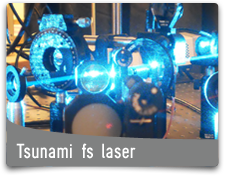
The Tsunami® mode-locked Ti:Sapphire laser provides fs pulses with a broad wavelength range and high power levels.
Click here to read more about the laser's Key Features...
Pulse width: 100 fs. Output power: 3 W. • Tunable: 700–1080 nm. • Regenerative mode-locking for long-term stability, prevention of pulse dropouts, broadest wavelength coverage.
Applications:
• Multiphoton microscopy • Time-resolved fluorescence • Pump-probe experiments • Nonlinear spectroscopies • Optical-computed tomography (OCT) • Surface second harmonic generation (SHG) • Amplifier seeding • Terahertz imaging • Materials processing • Ultrafast ultrasonics
|
 |
Asylum Research Cypher Atomic Force Microscope
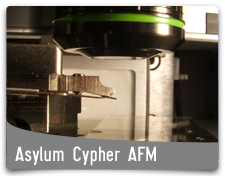
- High quality tapping mode imaging at 40 Hz with 5 MHz levers
- Most accurate images and measurements
- Atomic point defect resolution
- Automatic laser and photodiode alignment for ease of use
- Closed loop atomic resolution
Click here to read more...
- Automated Laser alignment
- Laser spot sizes as small as 3µm enable high-speed AC imaging with cantilevers smaller than 10µm.
- Immune to normal environmental vibration
- Interchangeable modules
- Crystal clear viewing of sample and tip
- Thermal control and acoustic isolation
|
 |
Asylum Research MFP-3D AFM
- Sensored, closed loop positioning for high resolution imaging, accuracy, and reproducibility.
- All-digital controller for open software adaptability, power and flexibility.
Click here to read more...
- Real-time 3D rendering, nanolithography/nanomanipulation, and Dual AC™ Mode for dual resonance and harmonic imaging.
- Flexible and expandable, wide range of available system, environmental and application options to enhance capabilities, including nanoindentation and Piezoresponse Force Microscopy (PFM).
- Low noise, eliminates interference
- Precise and accurate XY scanner
- Three configurations for illuminating and viewing of samples:
1. Top view for opaque samples 2. Bottom view for transparent samples 3. Dual view for both viewing options
- All-digital configuration allows virtually the entire system operation to be controlled through the MFP software interface (IGOR Pro) for easy addition of new microscope capabilities.
- 100% digital for low noise, fast operation, and flexibility
- Field Programmable Gate Array (FPGA) and Digital Signal Processor (DSP)
- Fast analog-to-digital/digital-to-analog conversions
|
 |
Pump Probe
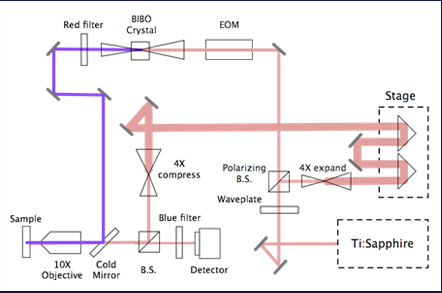
The Pump-Probe technique is an optical technique for determining the thermal properties of thin films. The setup is illustrated in the picture. We use a pulsing laser that emits laser pulses of 800nm wavelength at a frequency of 80MHz. The laser beam gets split into two beams: pump and probe. The pump beam is modulated through an electro-optic modulator and then undergoes a second harmonic generation that doubles its frequency.
Click here to read more...
The modulated pump beam heats the sample and gives rise to a thermal wave that propagates through the sample at a frequency identical to the pump modulation frequency. This changes the sample’s optical properties. The probe beam is delayed through a delay stage and hits the sample a bit later probing the state of the sample after the change in the optical properties occurred. The reflected probe admits a frequency component at the pump modulation frequency. This signal goes into a photo detector that converts the light signal into an electrical signal. The lock-in amplifier then detects this signal and gives back the amplitude and phase response of the probe. The lock-in amplifier data is fitted into the mathematical model describing the probe and given below:

where τ is the delay time between pump and probe pulses, ωs is the laser pulsing frequency, H(ωo) is the thermal frequency response of the sample weighted by the intensity of the probe beam, and β is a factor including the thermoreflectance coefficient of the sample and the power in the pump and probe beams.

|
The Masdar City Beam Down Facility was designed by the Tokyo Institute of Technology and built by Japan’s Mitsui Engineering and Shipbuilding Company. The system is comprised of 33ganged-type heliostats, surrounding the central tower, on top of which a faceted secondary mirror is mounted to concentrate the light on a high albedo target used for photographic flux mapping on a Lambertian receiver.
|